|
Tracks of His Mind novel |
|
|
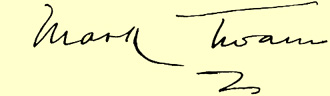
An older gentleman with a mass of frizzy white hair, bushy eyebrows, and a matching moustache ambles onto a stage. He's wearing a charcoal Callahan frock coat, a burgundy vest, a white tombstone shirt, and a black puff-tie pinned with a diamond. He looks over his audience before taking out his gold pocket watch and noting the time. He nods with approval, puts his watch away, and points an unlit cigar directly at you as he begins to speak in a Southern drawl. You don't know about me if you haven't read an essay by the name of "On the Decay of the Art of Lying," but that ain't no matter. That essay was made by me, Mr. Mark Twain, and just to prove my point I told the truth. There were things that I stretched, but mainly I told the truth, and that's pretty much what this book you're holding does. Maybe that's why the author and his publisher asked me to provide these introductory remarks, which I readily agreed to do, mostly because I got plenty of time and not a lot to do. Eternity is like that. It must be said at the outset, however, that I was a bit hasty accepting the fee. I grabbed the $100, which was a fair sum when I last worked in 1910, but ain't much these days. Well, they're gonna get what they paid for, which may or may not be true of anyone who buys this book. Books are like that. Being something of an authority on ghosts these days, I can tell you that words are just like 'em. They float around in the ether until the writer rassles 'em onto a piece of paper, where they haunt him for the rest of his life. That is certainly this author's fate. I am confident in saying so because he seems to have been motivated by an observation I made quite some time ago: all anyone needs in this life is ignorance and confidence and success is sure to follow. Perhaps you noticed that the author begins with a couple of epigraphs, which ain't nothin' but billboards lettin' ya in on the brand of snake oil he's purveyin'. The first is a line from the poem "Paradise Lost" by John Milton: Things unattempted yet in prose or rhyme. That's a pretty reliable clue that this here writer's got himself a liberal arts education. Dear me. He probably acquired it at one of those small colleges in New England that charges an exorbitant tuition despite having an endowment greater than the net worth of most South American countries. One thing you can be sure of, anyone who attends such a school and pays any tuition at all sorely needs an education. The second quote is attributed to my friend Oscar Wilde: The true artist is known by the use he makes of what he annexes and he annexes everything. That's a tad worryin'. Hasn't the author got any thoughts of his own? And another thing, what sort of writer has the gumption to label himself an artist? What is an artist, anyway? I raised that question at my book club. The consensus was that an artist, like beauty, exists in the eye of the beholder. (Yep, all those folks in your book club who spout nuthin' but clichés week after week got a chance of gittin' into heaven, too.) That seemed to end the discussion until this guy John spoke up, which was unusual because he usually passed the time doodlin' the same witchy–looking Asian woman-naked and in all kinds of positions! Imagine. Anyway, he said, "Being an artist myself, I believe I know." Whoa Nelly! An artist? I'd never seen the guy produce a watercolor or an oil painting or a sculpture—nothing! The only "books" I'd seen him write were filled with childish drawings. As for composing a prelude, a nocturne, or even an étude—nothin'. I have seen him traipsing around with a tuba, but I'd never heard him get a single note out of it. "You're an artist? How's that?" I asked. "I write popular songs, hyporchemata." "Do you have a stage name?" "I'm Sexy Sadie II." "You don't say." "Are your songs on the wireless?" asked our moderator-hostess, her voice made pleasant by the satisfaction of having had everyone rave about her snack of pastries filled with prosciutto and roasted red pepper. "If so," said another woman testily, "give us a verse." That was Lilian, who was entirely miffed because everyone had panned the book she'd chosen, a seven-volume novel by Vollmann that someone said was "good for sinking the Titanic and little else." To be honest, she was a strange and vanity-devoured, detestable woman! I do not believe I could learn to like her except on a raft at sea with no other provisions in sight. Damn if Sadie didn't oblige her by singing, "I am the egg man. We are the egg men. I am the walrus. Coo-coo-ca-choo." I'm serious. Everyone sat quite a spell thinking that one over, let me tell ya, sayin' absolutely nothin' until Ginny proclaimed in a haughty manner that it sounded like the lyric of "a queasy undergraduate scratching his pimples." Sadie mumbled back in a stony voice something about Ginny takin' a long walk off a short pier, and the meeting broke up. I trudged on home, discussing the matter with my friend, the Abstract Expressionist painter Nat Tate, who was never known to say a word. I suggested that the lyric might have something to do with mythology, Orphic eggs and such. Nat wasn't so sure about that. Perhaps, he suggested, the song was a veiled reference to the paradoxical G. Alonso Oeuf. "Maybe! Or to the androgynous Mr. Briscoe," I suggested. Not bad guesses, not bad at all—but who could say for sure? We'd just decided to ask our friend Ts'ui Pên about it in the morning when Sadie came up from behind, threw an arm over each of our shoulders, and whispered, "The walrus was Paul." Ah, now we were getting somewhere. "Paul?" I asked. "The guy on the road to Damascus, the guy who wrote all those letters to the Ephesians even though they never wrote back, not even a postcard? That Paul?" Then he winked. If you were ever wondering what conversations are like in the Hereafter, now you know. They're a whole lot like this book that I'm supposed to be telling you about. They seem to include everybody and everything under the sun except that the sun burned out a couple of millennium ago. None of you have lived long enough to know that. It won't go dark until well into your future, so whenever someone says "there's nothing new under the sun," git ready to tell 'em what my friend Amaurón says, "except darkness." Now then, where in hell was I? (People in heaven just crack up saying that.) Oh yea, this book! You'll find it's got plenty of regular narrative, although you won't be able to separate the fact from the fiction without at least one stick of dynamite. It's got poetry, the odd interview, some Dionysian imitato (not old-fashion mimesis), a parable, a fable, a quote from Clark Gable, buckets of Menippean satire, and something the egg man could really coo-coo-ca-choo about, some angry chanting that's supposed to be edgy urban music called hip-hop but it's more like sheep-dip. This here book has even got lines from moving picture shows and jingles from television advertisements and sitcoms. Oh yes, I've seen television. Utter claptrap! With some exceptions, of course. I saw a documentary film about me by that fellow Ken Burns, who happens to live in New Hampshire just like the author of this book. There was things that Burns stretched, but mainly he told the truth. The film was shown on something called PBS, which I gathered was one of those religious networks because it had all kinds of clean, smiley people with pleasant voices asking for money and implying that donors would receive some sort of salvation or redemption in return. Give so much, you got a coffee mug; give a little more, you got a rather prissy looking saddle bag that was good for carryin' books but not grub; and if you gave a heap of money, you got a recording of the show ya just finished watching, which didn't make no sense at all. I coughed up the big cash anyway 'cause the show was about me, and it solved for one more year the mystery of what to get my mother for her birthday. As I was saying, this book has even got a fable, which teaches a lesson, presumably that you can't make money selling books with fables these days. It's also supposed to be funny, and I sincerely believe it is—in both senses of the word. But as for all the infernal allusions, Lordy me! I asked the author, "Why so many?" He told me that back when he was in school his friends had a ball figuring out who all the characters were in a song called "American Pie" by a fella named Don McLean. Crowley figured what the hell, why not write a whole book filled with allusions that everyone could scavenge—just for the fun of it! It would be, in his words, "like a giant egg-hunt on a secular Easter, a day on which readers could raise from the dead the ideas and ideals of my generation." Then he said, "Let other pens dwell on guilt and misery," which he stole from Stella Gibbons, who stole it from Jane Austen, who probably stole it from some fishmonger. Authors are like that, don't I know it." Anyway, with this gnomic and daedal book ya gotta be prepared for yellow brick roads, yellow submarines, and a supposedly grown man who thinks it best if you call him Mellow Yellow. If that don't tickle yer fancy, work on identifyin' the guy who's always thinking about kissing "the plump mellow yellow smellow melons of some girl's rump"—sorry ladies, I'm just quoting here—"with obscure prolonged provocative melonsmellonous osculation!" Frankly, Jim and I couldn't make heads or tails out of most of it. Jim! That reminds me. People are always asking me about Jim, the slave who ran away with Huckleberry Finn. "How's Jim gettin' on?" they always ask. "What's Jim been up to?" they want to know. People didn't care so much about folks like Jim back in my day, so I reckon all that sensitivity training is doing you people some good. Any old ways, Jim is just fine. I put him in a new novel a ways back, but none of you have had the chance to read it and I'll explain why. In the story, Jim and Miss Watson are co-owners of a popular jazz club, The Dauphin. She put up quite a fuss insisting on having the key management position, I suppose because she thought that working 70 hours a week would show everyone that she was a liberated woman. My, my. Well, she got her way, and that left Jim plenty of time to play golf at a fancy club, not because he enjoys the game, but because he gets to take a white caddie. Jim's a hoot! In the book, he penned his memoirs, which turned out kind of lengthy, so I had my literary agent try ta git 'em published separately. Sure's shootin' that ruffled ol' Jimbo's feathers. He went out and hired hi'self a lawyer and got an injunction against the publication of both books! He reckoned that since I can't own him—slavery being illegal and immoral—most of the proceeds rightfully belonged to him. I reminded him that he's a fictional character, but that just set him off like a mad dog, growling that I was just another example of "The Man trying to keep a brother down." I have no idea where he learned to talk like that. As they say, we're in negotiations, meanin' his people "do" lunch with my people for weeks on end and I get the bills. Lawyers are like that, don't everybody know it. To get my mind off the matter I took this assignment. It seemed straightforward enough. Then I commenced trying to make sense out of all the inane rock 'n roll lyrics, the pretentious paronomasia, the playful puns and parodies, the pathetic prosody, the rambling runes, the ludic logodaedaly (can ya tell I use that Word-of-the Day website?), and the unending dialogue from books I ain't read and films I'm never gonna see. Kept me busier than a three-legged dog with fleas. Throughout the process I kept thinking that the publisher should have given the job to James Joyce—as penance for writin' such high-falutin' novels. Let that smart-ass, polyglot Irishman—excuse me again, ladies—try to find something as simple as a plot in this here book. Best 'a luck, Keem-o-sabe. Maybe this book is tryin' to take its readers on a journey or a quest. Its author does have the same birthday as Miguel Cervantes. Remember him? He wrote that book about Don Quixote and his quest 'cept he called it "sallying forth." Quixote ventured out with his sidekick, the hopelessly naïve Sancho Panza, tiltin' at windmills and romancin' women of the night he mistook for noble señoritas and seeking . . . what the heck was it anyway? All I know is that at the end of that book Quixote didn't seem to have any better grip on reality than when he started out but I was supposed ta. Tracks of His Mind is kinda like that. It's like going on an expedition through the mind of the protagonist—a so-called "Baby Boomer" named Clondale—and trying to figure out who he is by paying attention to what it was about his time and place that made him tick. The trek involves quite a cast of characters. Most of them are pleasant, optimistic folks because they're the sort of people that Clondale bothers hanging around with. Can't say I blame him, no sir. There's other characters with plenty of angst though, and that's a good thing because a writer can't be accused of producing quality literature unless he includes at least a few characters willin' to whine about the pointlessness of life. No problem here. They'll just love Anthony, who wonders if a house out in Hackensack really is all you get for your money. (Apparently, knocking Jersey never goes out of fashion.) They'll latch onto Lola, L-O-L-A Lola, who moves from A.C. (Atlantic City) down to D.C. en travesti and winds up dating a third-rate burglar named Gordon, who suffers a midlife crisis and escapes to Guyana, where he becomes the head bartender at a remote resort run by expatriates from San Francisco. The author never says, so only God knows what happened to Gordon and the rest of those folks. As for Lola, it's a mixed up, muddled up, shook up world, so the vivacious Miss Berdache changes her name to Laura, moves to the environs of New York City, (bypassing the last exit to Brooklyn), and settles down in New Rochelle, where she marries a nice fella named Rob. Whatever Laura wants Laura gets, and she wants twin beds for herself and hubby. Even so, they manage to have a son, but no one can remember the kid as a baby, so he could have been adopted or found floating in a bulrush basket amongst the reeds at Five Islands Park for all anybody knows. Kind of sad that Laura, L-A-U-R-A Laura, couldn't have kids natural like. Now I can just imagine Joyce sitting in Davy Byrne's (Moral) Pub over there in Dublin on Arthur's Day and reaching precisely this point in Tracks of His Mind. He drains his pint of Guinness, smashes the glass on the bar, and slits his throat with the jagged remains because he can't take anymore. He slumps down and dies face-first in a puddle of Celtic Tiger piss—ladies, I beg your indulgence—that's pooled beneath the barstool of a married young man who has just realized that he owes way more on his townhouse in Rathgar, his BMW coupé, and his villa in the Algarve than each is worth. That's not unusual for someone of his generation. It is, however, a matter of immediate concern because he's just received a message from his boss saying that he's "been given the sack" by Allied Irish Banks because he "approved too many bad loans" and would he "kindly return all his company-issued mobile devices and credit cards in the morning, when we'll discuss your personal overdraft. Cheers, Róisín." Americans are made of sterner stuff, or maybe they're just plain mule-headed, so I read on. Sprinkled throughout the text is a fair amount of American cultural and political history, but don't worry, the author doesn't get too deep. At one point, however, he uses Joyce's literary technique with a bunch of newspaper headlines.
Kids get Head Start. I found such social progress quite impressive. I'm sure it didn't come easily. It must have taken courage because progressive social legislation is always opposed by people who want to preserve the status quo. They called themselves conservatives back in my day. "Things is just dandy," they were always saying. "This is the greatest country in the world, so don't change nothin' and stop yer complaining." They didn't seem to realize that change is inevitable and that it comes at a price. Fortunately, enough folks that git involved in politics do. I imagine nearly all Americans are proud of our great liberal tradition, which has brought us tremendous social progress, meaning compassion and justice for everyone. Yes sir, that's what I can only imagine. Well, it's about time I mosey along. Before I go, I must admit that I've been kinda skeptical about the new-fangled style of writin' in this book. But I ain't alone. My poet-friend Reginald said it was likely to suggest "extremely unusual things to absolutely unlikely people." And my buddy Witwoud called the author "a mere retailer of phrases, one who deals in remnants of remnants, like a maker of pincushions." And you, dear reader, are apt to feel like pincushions with all the jabs Crowley's gonna give ya. Indeed, this book is filled with a whole lot of mischief, the kind that would make the Devil whoop as he whooped of old. To be fair, however, my stingy praise is probably due to the miserly fee they dun give me. But whether you like this book or not, kindly take some advice of mine that I'm pretty sure the author embraced: Keep away from people who try to belittle your ambitions. Small people always do that, but the truly special people are those who make you feel that you can be great too. And before I go, I see here in my contract that I'm supposed to remind you of something else I said years ago: The man who does not read good books has no advantage over the man who cannot read at all. True enough, but having me remind you folks is just the publisher's way of using two-bit psychology to twist yer arm around behind yer back so you can fetch yer wallet. While you're doing that I'll remind its author that the man who has not written a good book has no advantage over the man who cannot write at all. Well, that's about all I got to say about this book, which ain't been much and shouldn't really matter. Book reviews are like that. I don't believe I've described it very well, but I am comforted by what my friend Edward Gorey once told me, "Ideally, if anything were any good, it would be indescribable." Sarsaparilla is kinda like that, ya reckon'? So, I best be getting' back home to Elmira. I'm having an old friend for dinner. No, not Dr. Hannibal Lecter but another polymath, the aforementioned Amaurón. Thank y'all for comin' and have fun readin',
NEXT SECTION: Prologue |
| Home | Copyright & Terms of Use | Prologue | Chapter 1 | Chapter 2 | Chapter 3 |
| Chapter 4 | Chapter 5 | Chapter 6 | Chapter 7 | Chapter 7–Annotated | Author |
| © 2012, Ronald S. Crowley. All Rights Reserved. | |||||